Return to office mandates became a trend, a risky one
In 2025 and 2026, a wave of companies started requiring employees to return to the office. Big names like Amazon, Microsoft, Apple, Google, and Meta pushed hybrid models, asking people to be between 2 to 5 five days a week in the office.
The official narrative was familiar: better collaboration, stronger culture, improved productivity. But beneath the surface, something else was happening.
Return to office mandates are often a response to deeper issues: a desire for more control, pressure to reduce headcount without formal layoffs, and leadership styles that never adapted to remote work.
And now companies are discovering that presence doesn’t automatically create performance as recent studies demonstrate, and in many cases, RTO is accelerating the very problems it was meant to solve.
Does presence automatically mean results?
Most leaders still assume that bringing people back to the office will improve collaboration, communication, culture, and productivity. It’s a comforting belief, but an outdated one.
Physical proximity doesn’t guarantee better work. Productivity comes from clarity, trust, and clear ways of working.
Recent data reinforces this: fully remote employees report higher productivity (44%) than those fully in‑office (34%). The gap is more about how work is structured, rather than just the location.
RTO mandates oversimplify the real problem.They assume that visibility equals accountability and that collaboration magically improves when people share a building. But without clear goals, strong communication norms, and aligned expectations, office time becomes useless.
The truth behind RTO
The debate shouldn’t be remote vs. office. If collaboration and productivity aren’t the true drivers, what is?
Control and leadership gap
Some leaders feel uncomfortable managing what they can’t see. Rather than developing the skills to lead distributed teams, they pull people back into the office to regain a sense of control. It’s a management problem dressed up as a culture solution.
When a team underperforms remotely, the instinct is to change the location rather than diagnose the real problem, and default to the simplest lever they know: physical presence.
Take Amazon as an example. After its RTO push, the company introduced performance-based reviews and clear metrics to measure productivity, rather than relying on visibility in the office only. Indeed, it’s not about where employees sit, but how leadership defines success and ensures alignment.
Soft layoffs
When flexibility disappears, some employees choose to leave on their own. This reduces headcount without severance or public layoffs: a convenient outcome in a tight market.
Let’s go back to the Amazon example. Their own data showed that after the 2023 RTO announcement, resignation rates spiked, especially among senior and high-performing employees.
Pressure from investors and real estate
Companies with expensive office leases feel pressure to justify the cost, and local governments want downtowns to be full again. When a company has committed to huge office space, every empty desk becomes a problem in board meetings. And when entire business districts empty out, cities lose tax revenue, foot traffic, and the local economy that depends on office workers showing up.
None of these reasons is malicious, but none of them improve performance either.

Why return to office mandates backfire
Companies that enforce RTO eventually face predictable consequences:
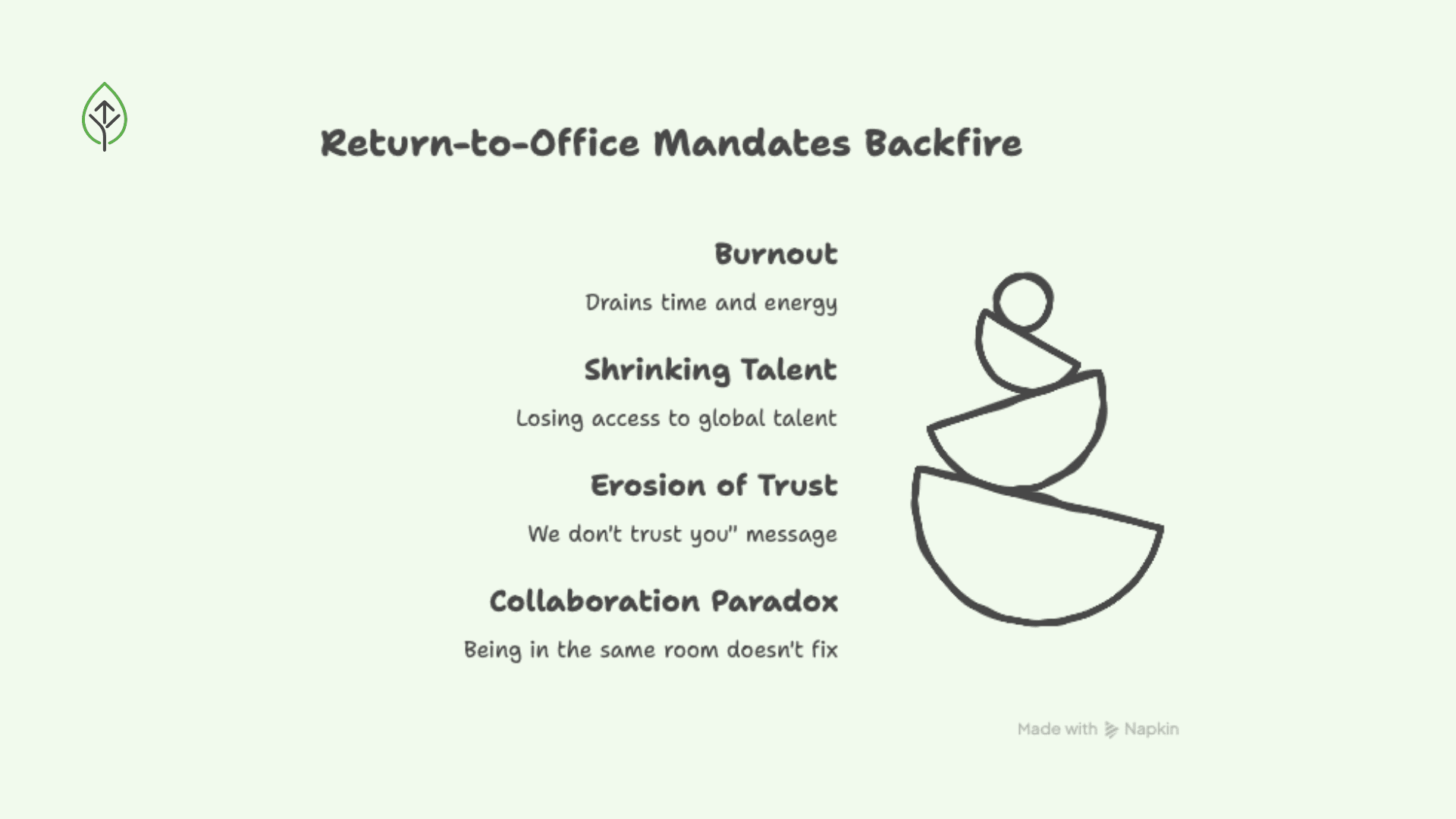
Burnout and reduced focus
Commuting drains time and energy. Long commutes (over 45 minutes) make employees tired, increase stress levels, and reduce sleep, making workers 33% more prone to depression and decreasing engagement of 40% compared to those with shorter journeys.
Shrinking talent pools
Requiring proximity means losing access to global talent. In a market where the best candidates have options, flexibility is the baseline expectation. Top performers simply choose companies that offer it.
Erosion of trust
Mandating presence sends a clear message: “We don’t trust you unless we can see you”. As a result, engagement drops and culture weakens. And once trust erodes, nothing rebuilds it.
The collaboration paradox
Being in the same room doesn’t fix unclear goals or poor communication. Without structure, office time becomes a mix of noise, interruptions, and meetings that could have been async.
Next steps: how to avoid RTO
If companies feel the urge to mandate a return to the office, it’s usually a sign that something deeper isn’t working.
They can prevent it by:
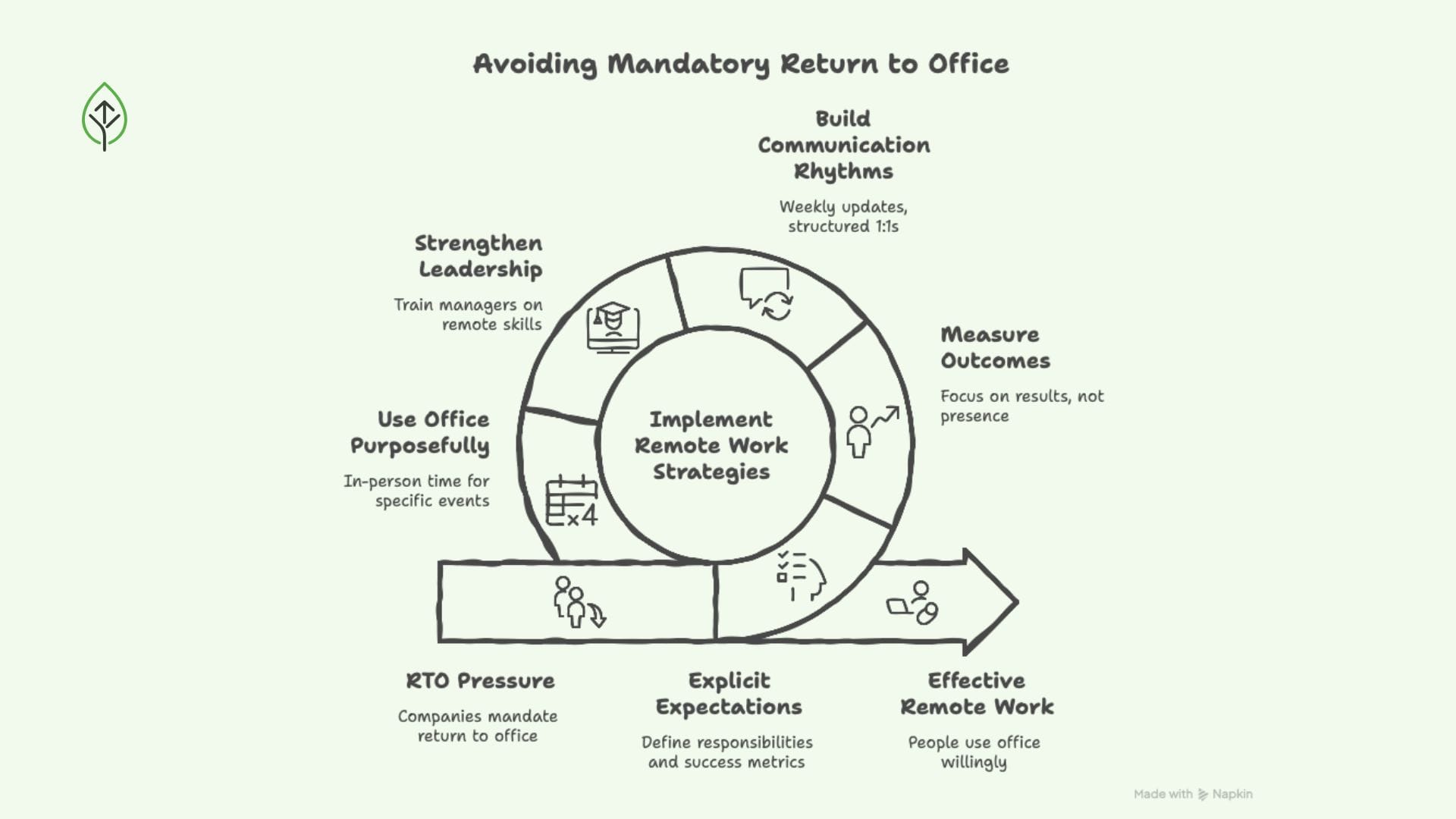
1. Making expectations explicit
When every team member knows exactly what they’re responsible for, what “success” looks like, and how it’s measured, you no longer need physical oversight. A team charter or a simple framework can make this shift real.
2. Measuring outcomes
Start small: define 2–3 measurable outcomes per role per quarter, and review them consistently. When performance is visible in results, nobody needs to be watched.
3. Building communication rhythms
Weekly written updates, structured 1:1s, and a shared workspace can replicate, and often improve, the information flow that used to happen by accident in hallways.
4. Strengthening leadership
Remote leadership is a skill: invest in training managers on asynchronous communication, outcome-based accountability, and how to run effective remote 1:1s. This is the highest-leverage intervention most companies skip.
5. Using the office as a tool
When in-person time is purposeful (like a quarterly offsite, a product sprint, an onboarding week), people use it willingly and get real value from it. The moment it becomes mandatory and routine, it loses its power.
These steps fix the real issues behind RTO pressure.
The future isn’t about return to office mandates
Return‑to‑office mandates make headlines, but they rarely solve the problems leaders hope they will. In many cases, they accelerate turnover, weaken culture, and reduce access to top talent.
The companies that thrive won’t be the ones forcing people back into buildings. They’ll be the ones designing work around clarity, trust, and meaningful collaboration.
The question was never “where do people work?” The question has always been “how well is the work designed?” Answer that, and location stops being a debate.