Working relationships matter more than you think
Hiring globally has never been easier. Remote-first companies can access talent anywhere, structure teams across time zones, and scale faster than traditional organizations ever could.
However, this opportunity leads to a critical challenge for companies: deciding how to structure their remote working relationships. This decision affects not only culture and operations, but in some cases even legal and tax exposure.
The structure you choose shapes how your company scales, how culture forms, and how resilient you remain when things get hard. We often see companies opting for the wrong structure and unintentionally weakening their foundations.
The way you hire determines the way you scale.
Contractor vs Employee: why this isn’t just an HR decision
Most companies treat the contract choice as paperwork, just an administrative classification. In reality, it’s a strategic decision, closer to choosing an operating model than selecting a contract type.
Many founders opt for employees because it feels safer. Others default to contractors because it gives flexibility. If you’re unsure what a contractor is, we created a simple guide that explains the basics. In short, contractors work independently, control their methods, and often serve multiple clients.
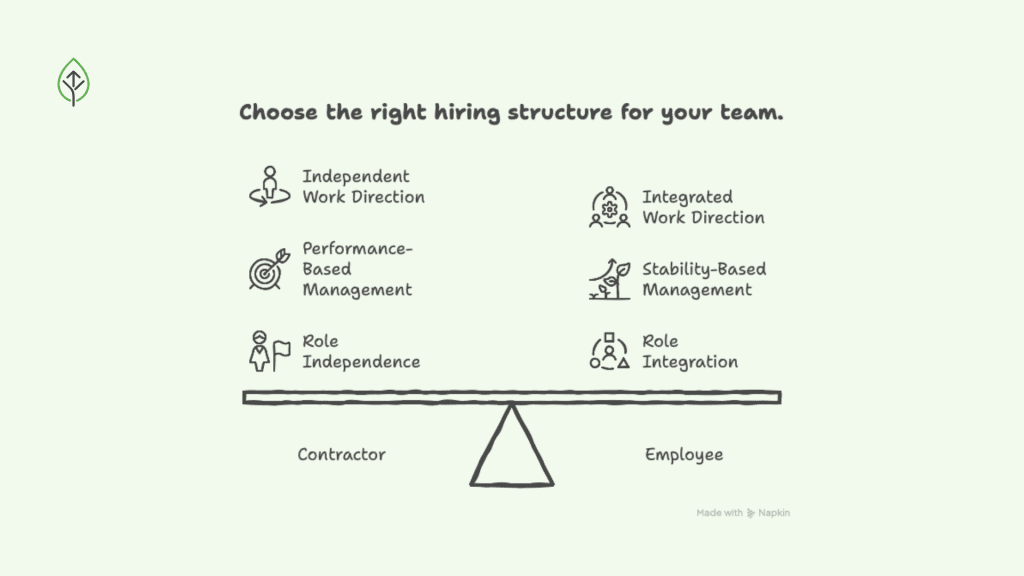
The true distinction between contractors and employees isn’t flexibility versus stability, as most people think; it’s rather independence versus integration.
There’s no universal right choice, as it all depends on how the work functions inside your company.
A wrong choice can lead to:
- Operational instability
- Inconsistent culture
- Loss of control
- In some cases, even legal exposure due to misclassification.
This last point is especially critical when managing international talent. If someone works like an employee while living in another country for more than six months, the company may unintentionally create a “Permanent Establishment”. This creates a taxable presence in another country, due to ongoing or substantial business activities there.
In practice, this can trigger local labor obligations and expose the company to corporate taxes, as if that remote worker were an unregistered local branch.
This is why the structure you choose shapes how authority flows, how leadership operates, and how accountability is shared.
A practical example: OpenAI decided to use consultants and external specialists during acceleration phases, not to replace core teams, but to increase speed around clearly defined problems. This is a strategic decision that leverages the speed and flexibility of working with consultants.
The integration test: is this role truly independent?
When the structure matches the nature of the work, the company becomes more stable, more scalable, and easier to transition, whether through growth, leadership changes, or acquisitions.
Once you understand how the work actually functions inside your system, the distinction becomes clearer.
Every role either operates with real independence or requires deep integration, and this is where the contractor vs employee decision becomes strategic.
Remote work amplifies this difference because you’re essentially choosing how the role is managed (not just how it’s paid!). If a role truly operates independently, a contractor setup brings clarity. If the role is deeply integrated into the company, an employee structure brings stability.
Contractor vs employee: a structural comparison
Take a closer look at the main difference between a contractor and an employee. The right answer depends less on cost and more on alignment.
| Dimension | Contractor | Employee |
|---|---|---|
| Work control | Controls how and when work is done | Operates within company-defined systems |
| Economic model | Independent income, multiple clients | Primary income from one employer |
| Integration level | Limited integration | Inside strategies and operations |
| Risk distribution | Business risk individually | Risk shared institutionally |
| Best use | Defined projects, specialized expertise | Ongoing roles, strategic continuity |
| Cultural impact | External contributor | Internal culture builder |
| Misclassification risk | High if treated like employee | Low if managed correctly |
Next steps
When defining your hiring models, three questions can help you clarify the right structure:
1. Control test: Do you need to control how and when the work happens?
Start by asking yourself:
- Who decides when the work happens?
- Who defines how it happens?
- Who sets priorities and tools?
Contractors typically control methods and execution, while employees operate within company systems.
You’re already operating in employee territory if you:
- Set fixed working hours
- Require daily reporting
- Provide mandatory tools
- Direct how tasks must be executed
2. Dependency test: Will this person rely on you for 80%+ of their income?
Choosing contractors means accepting that they usually:
- Work with multiple clients
- Carry their own business risk
- Manage their own taxes and benefits
- Price work based on scope or outcome
An employee structure, on the other hand, typically means:
- Depend primarily on one employer
- Expect continuity
- Build long-term growth internally
- Trade autonomy for institutional stability
If someone relies on you for most of their income, they’re basically an employee, legally and practically.
3. Strategic test: Does this role shape product or culture?
Not every role carries the same weight.
Contractors work well when:
- The project is clearly defined
- The expertise is specialized
- The outcome is measurable
- The engagement is bounded
Employees make more sense when:
- The role is ongoing
- The function is strategic
- The work evolves with the company
- Cultural influence matters
If a role shapes your intellectual capital, product direction, or culture, it’s foundational, and it shouldn’t feel temporary.
Audit your current structure
The companies that scale and stay stable do one thing consistently: they align the structure of the contract with the reality of the work.
Alignment between structure and operational reality builds resilience and long-term scalability.
Begin by aligning roles with the way work actually gets done:
- List all your remote roles
- For each, ask: Does this role shape product/strategy? Does it need to be on our schedule? Is it a defined project or ongoing?
- Identify mismatches: contractor doing employee work? Employee doing contractor work?
- Fix them intentionally
This is the strategic power behind choosing a contractor vs employee with intention.